Organic Rankine Cycle
OVERVIEW
Conventional power generation by the Rankine Cycle uses water steam as the process fluid. The organic Rankine Cycle, however, utilizes organic fluids in its process cycle. Organic fluids have low boiling points, which makes it possible to extract energy from low-temperature heat sources, which was not possible or feasible previously by water-steam cycles. Potential low-temperature heat sources can be solar, geothermal, biomass, or waste heat.
In the ORC setup in our laboratory, hot heat transfer oil is supplied to the system to simulate the heat source. The hot heat transfer oil goes into the evaporator, which transfers heat to the pressurized organic fluid, causing a phase change from liquid to gas. The organic fluid at high pressure and temperature then goes into a rotating expander (presently scroll type and in future radial type). This energy is converted into mechanical energy, causing the shaft rotation, which is connected to a generator producing electricity. Leaving the expander, the organic fluid goes into the condenser, which cools down and condenses. A chiller provides the required cooling water to the condenser. The condensed organic fluid is then pressurized using a pump feeding the evaporator. Thus, the cycle is completed.
This ORC setup is planned to use different heat sources; however, priority is given to solar energy. Concentrated solar energy using parabolic trough collectors will be the first renewable energy heat source to be studied in the laboratory. Other low-temperature heat sources such as geothermal, biomass, or waste heat also fall in the research scope of BURET.
The research and development activities of BURET will cover the following areas:
- Steady-state and dynamic modeling of various organic Rankine cycles
- Refrigerant performance evaluation
- Cycle optimization
- Radial and scroll-type turbine design
- Heat transfer equipment from various heat sources to the organic fluid.
LABORATORY HARDWARE
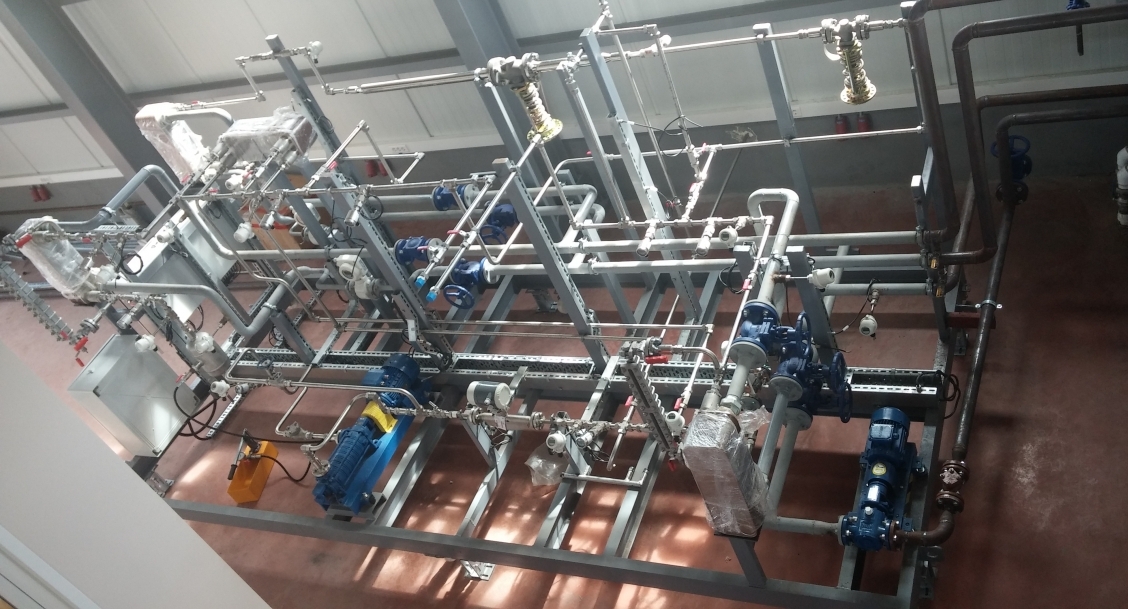
The ORC set-up in the BURET Laboratory consists of both on-skid and off-skid equipment. On-skid equipment covers an overall volume of 25 m3 (5m height x 2.5m width x 2m height). It consists of three pumps, one for each cycle (organic fluid, water, and heat transfer oil), four heat exchangers (evaporator, condenser, simulator, and recuperator), two throttle valves to simulate the expander during the startup process, a condensed liquid collector at the suction side of the organic fluid pump, complete with interconnection piping, valves, and instrumentation.
Off-skid equipment mainly consists of a scroll-type expander, chiller, and air compressor units, an electric heater, an expansion vessel for heat transfer oil, and a shell and tube heat exchanger to condense and recover the organic fluid that may be discharged from safety valves during operation.
A data acquisition system monitors and collects the flow, pressure, temperature, and level measurements online.
The system’s design pressure and temperature are set to 30 bar and 2000C.